Loading...
-9%
Gum
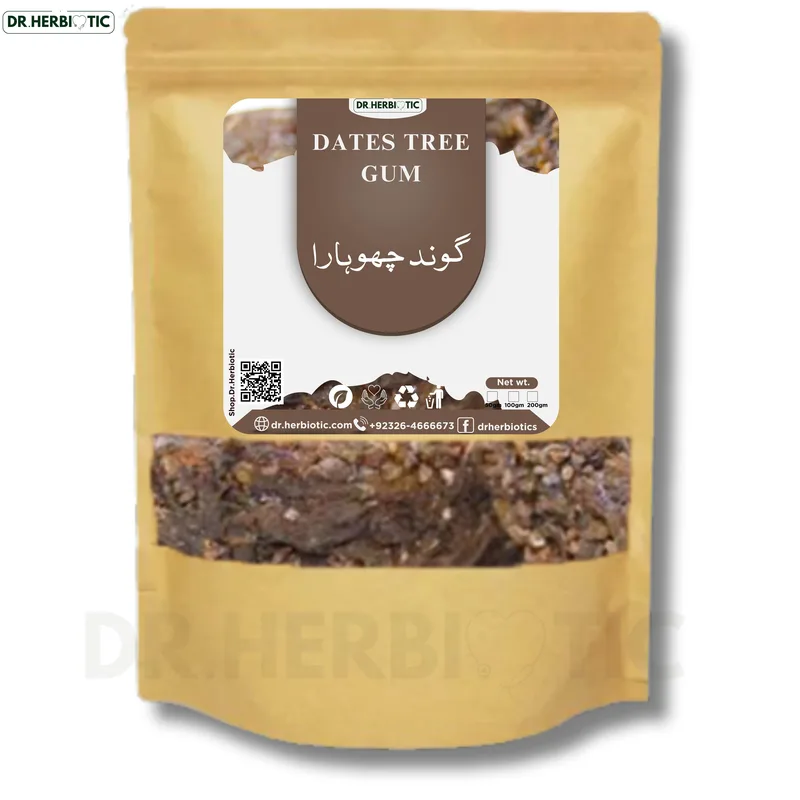
Dates Tree Gum
Rs. 820Rs. 900-9%
In StockSKU: DAT-165
1
Product Details
- Local Names
- گوند چھوہارا
- English Names
- Dates Tree Gum - Gond Chuhara
Gond chuhara, the gum of the date palm, has a story that is quite different from the tree gums of the hills. The date palm is known all over the southern world for its fruit, and in the old irrigation channels of Sindh and Baluchistan it is known for another reason: when the palms are cut for their dates, the trunk gives out a thick, dark, sticky sap that hardens into lumps and flakes. Collectors boil and dry that material into the brown gum sold as gond chuhara.
The appearance tells the story. Unlike the pale, translucent ribbons of acacia or tragacanth gums, gond chuhara is deep brown to almost black, with a dull, slightly waxy surface and a smell that is heavy, sweet and malty rather than resinous. In texture it is dense and it breaks rather than bends, which is why it is traditionally used where body and thickness are wanted rather than clarity.
In the herbal and sweet traditions of Pakistan this gum has a firm place. Ground coarse it is stirred into syrups and halwa to give weight and a dark glow, and in the classical preparations it appears with rose water and dry fruit, where its colour becomes part of the look of the finished sweet. It is also one of the ingredients that finds its way into winter drinks, where a small amount adds a rounded sweetness and a thick, warming body.
The palms that produce this gum are the same date palms of the Indus region, and the collection is seasonal. Dr Herbiotic sources gond chuhara in small lots from collectors and traders who work directly with the palm groves, and the material is cleaned and sorted so that the packets arrive dry, free of sawdust and ready to grind.
It is a dense product with a strong flavour, so a little goes a long way. A 50 gram pack is enough to try it in a family dessert, while the 200 gram jar is the one that regular users of halwa and syrup keep on the shelf. Store it sealed and away from damp, and grind it fresh each time for the best aroma.
Gond chuhara is unusual among the gums because it does not come from a wound in the bark at all, but from the cut trunk of a palm that is being managed for its dates, which is why the palm groves of the Indus region are its real home. Dr Herbiotic buys it in small lots from the traders who work between the groves and the markets, and the material is dried until it stops being sticky and is then sorted so that the sawdust and the bark chips stay out of the packet. It is worth noting that the dark colour is not a sign of poor quality, it is simply what this particular gum looks like, and the difference between good gond chuhara and a bad batch shows up in the smell rather than the colour: the good material is sweet, malty and clean, while a poorly dried batch smells sour or musty. Keep the packet sealed, keep it in a cool cupboard, and grind it fresh, because that is when the aroma is at its best.
Reviews
No reviews yet — be the first!